
Field Engineer Intern, Marco Giannetta shares how working on the Brooklyn Bridge–Montgomery Coastal Resilience Project helped him apply an aerospace engineering mindset to complex civil infrastructure, develop real-world problem-solving skills, and gain a deeper appreciation for collaboration and adaptability.
While the connection between civil and aerospace engineering may not be immediately apparent, SPC’s Field Engineer Intern Marco Giannetta demonstrates that the foundation of engineering transcends industries, and how experience in one discipline can provide valuable perspective in another.
Marco is currently studying Aerospace Engineering at Auburn University, and he saw this internship as an opportunity to challenge himself, expand his skill set, and gain experience working on complex engineering systems in a real-world environment. New York City is the most densely populated city in the United States, and working on its infrastructure is no easy feat. It requires immense planning, coordination, and an understanding of complex urban development.
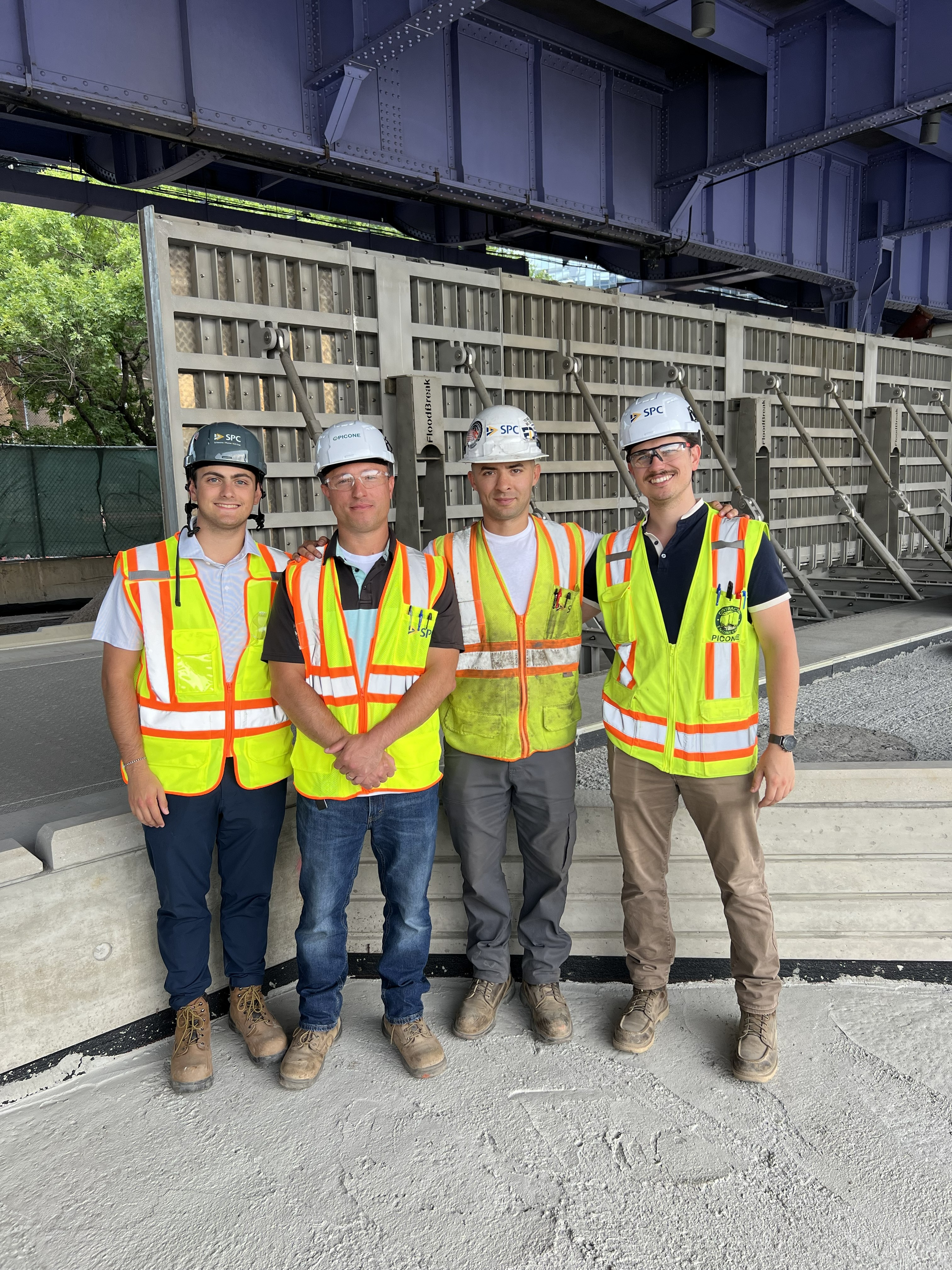
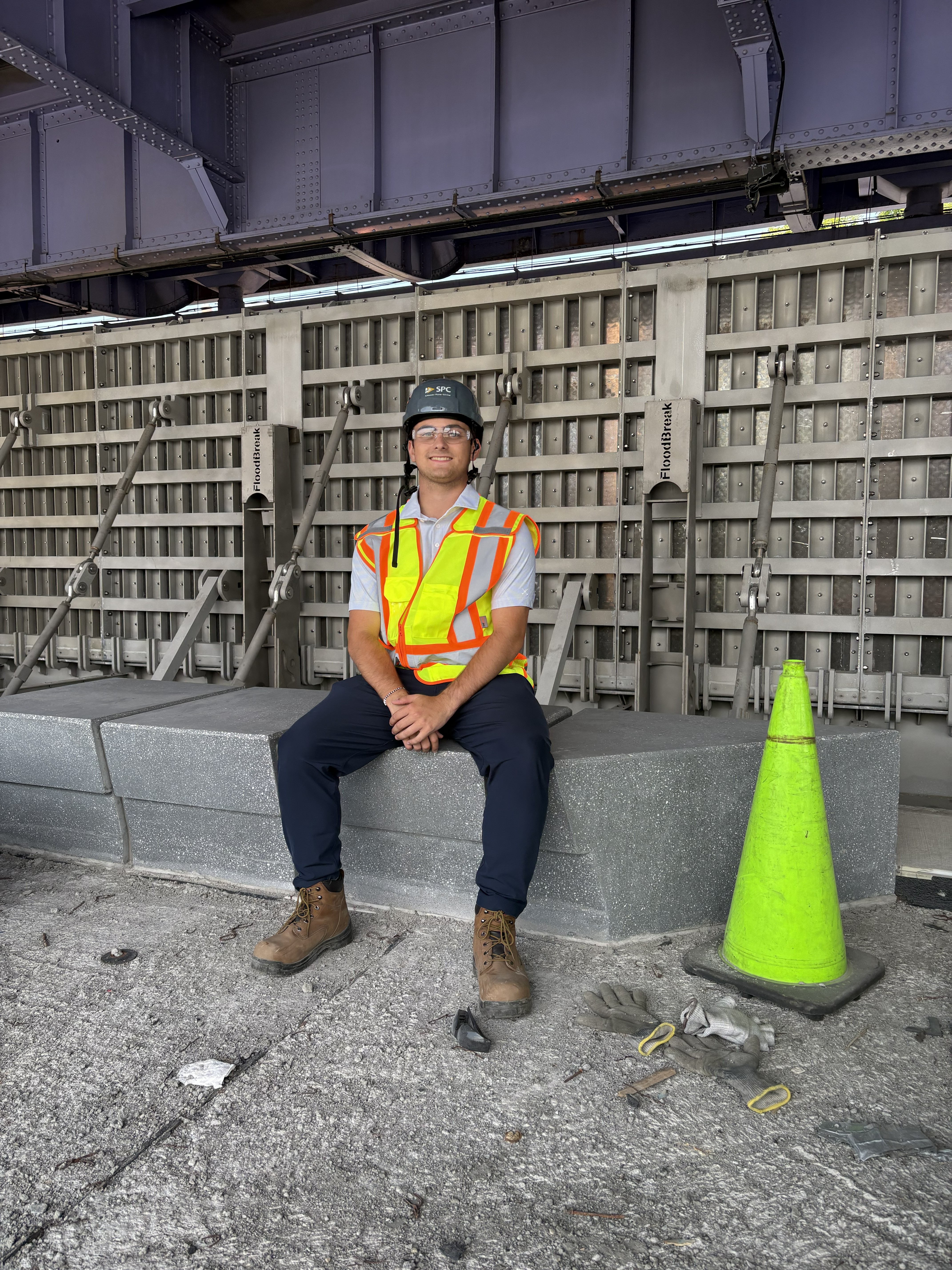
The Brooklyn Bridge–Montgomery Coastal Resilience (BMCR) Project showcases the technical expertise and engineering innovation required to deliver complex city infrastructure. It is on this project that Marco is spending his summer as a Field Engineer Intern, gaining firsthand experience with the challenges and solutions involved in building resilient infrastructure. The BMCR project extends approximately 0.8 miles along the East River waterfront from the Brooklyn Bridge to Montgomery Street and is designed to protect the Two Bridges neighborhood from coastal flooding. The project includes a system of flip-up floodgates integrated into landscaped pedestrian walkways, as well as permanent flood barriers, roller and swing gates, utility upgrades and an interceptor gate designed to improve drainage capacity during severe weather events.
Working on a project of this scale has allowed Marco to see firsthand how engineering concepts are transformed into physical infrastructure that serves and protects the surrounding community.
Throughout the summer, Marco's responsibilities have ranged from field coordination and dimension verifications to quantity takeoffs, drawing reviews, layout development, and coordination with subcontractors and outside firms. A major part of his work has been completing quantity takeoffs for the project’s precast elements. “When a new requirement affected the step layouts, I worked closely with my team to develop a solution that minimized changes to the existing precast step designs,” Marco explained. “I then produced revised layouts and dimensions based on that approach, which met the new requirement across all layouts while introducing only two new precast piece designs.”
"Whether you are working on an aircraft, a rocket, or a major infrastructure project, you need to understand the design, account for real-world constraints, communicate across teams, and develop a solution that can actually be built," Marco said.
For Marco, one of the most eye-opening aspects of the internship has been the contrast between classroom learning and professional engineering practice.
"In school, engineering problems usually have clearly defined information and an expected answer," he explained. "On the job, there may be several workable solutions, and you have to determine which one best accounts for field conditions, safety, cost, schedule, and the needs of other teams. This internship has taught me how to apply what I learn in the classroom when the problem is not perfectly defined."
His biggest takeaway has been recognizing the importance of communication and collaboration. “Successful engineering depends on more than technical ability," Marco explained. "You also need to communicate clearly, adjust when conditions change, and understand how your decisions affect everyone else involved. On a project of this scale, even a small detail can have an impact on several teams."
Coming into the internship, Marco hoped to gain experience solving real engineering and logistical challenges, which are skills needed in any engineering or professional career.
His aerospace studies have taught him to approach complex systems analytically, while this internship has challenged him to apply that mindset in a completely different environment. “Working on BMCR has broadened my perspective and made me a more adaptable, well-rounded engineering student."
He credits the BMCR Project Team for making the experience especially rewarding. “Everyone has been willing to answer questions, share their knowledge, and include me in meaningful work. That support has made it easier for me to learn, contribute, and grow throughout the internship”
“I would tell future interns to become comfortable not knowing the answer right away. As an intern, your value does not come from pretending to know everything. It comes from asking thoughtful questions, learning quickly, and applying what you learned the next time. I would also encourage interns to understand the project beyond their individual assignments. When you know why your work matters and who depends on it, you can contribute much more effectively."
By stepping outside the traditional aerospace path and embracing the challenges of heavy civil construction, Marco has demonstrated the versatility of engineering principles and the value of gaining experience in new environments. We have been fortunate to have him on the BMCR team this summer and look forward to seeing where his engineering journey takes him next.
 |  |